
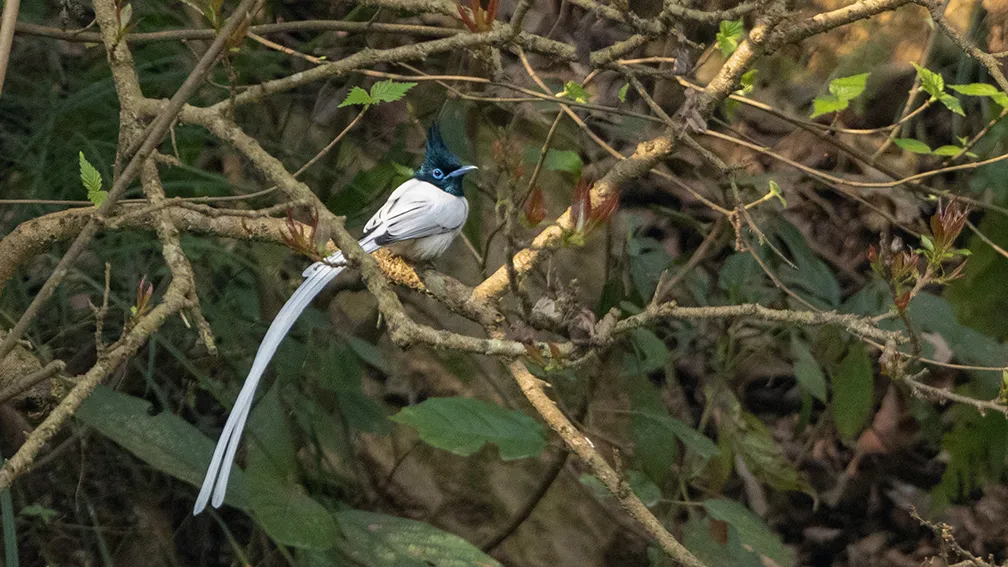
The paradise flycatchers are generally small birds, around 18 to 21 cm (7.1–8.3 in) in length and weighing 12 to 23 g (0.42–0.81 oz). They have a medium length grey or blueish bill which is broad and hooked at the end and is surrounded by stiff rictal bristles. The inside of the mouths of paradise-flycatchers are brightly coloured, being either yellow or green. The tails are long, particularly in many species where the male has a massively elongated pair of middle tail feathers. These tail streamers are 195 mm long in the male São Tomé paradise flycatcher and 412 mm long in the male Indian paradise flycatcher.
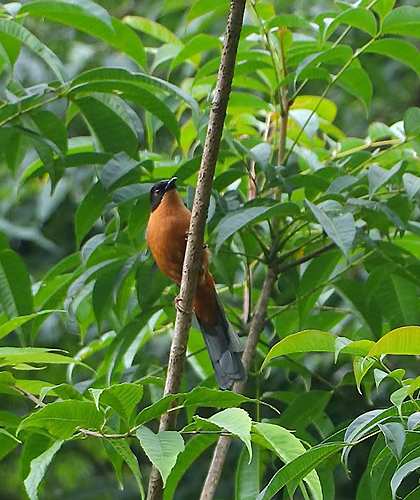
The function of the long tail is assumed to be related to sexual selection, with females choosing males based on the length of the tail. Not all species have long tail streamers, for example the blue paradise flycatcher of Palawan in Asia and the Bedford’s paradise flycatcher of montane Africa do not have exceptionally long tails. In most species the tail is longer than the wing, even in the shorter tailed females. The eye is surrounded by an eyering that is a blue thin wattle (slightly more pronounced in some species like the rufous paradise flycatcher).
Distribution and habitat H2
The paradise flycatchers have the widest distribution of any of the monarch flycatchers, ranging across sub-Saharan Africa, the Indian subcontinent, Southeast Asia and East Asia. At the northern extreme of its range it reaches Korea and Afghanistan. The species also occurs on a number of islands, including those of Indonesia and the Philippines, Taiwan, and Japan, as well as Madagascar, the Mascarenes and the Seychelles in the Indian Ocean and São Tomé off Africa’s Atlantic coast.
Breeding H3
Paradise flycatchers, like all monarch flycatchers, are monogamous and are generally territorial, although in some cases birds may nest close together and defend the nests together against predators. Females apparently select males based on their tail length, a form of sexual selection. Paradise flycatchers are unusual as exaggerated sexual traits are usually found in promiscuous birds, not monogamous ones. The nests of this genus are neat deep cups placed on a branch or twig, often in a fork. They are usually placed 1–3 m off the ground. They are often very conspicuous, particularly when the long-tailed males are incubating. The nests are, however, aggressively defended by the pair. Amongst the pair duties are shared but not equally. For example, in the Malagasy paradise flycatcher the female undertakes more brooding responsibilities whereas the male spends more time guarding the nest.